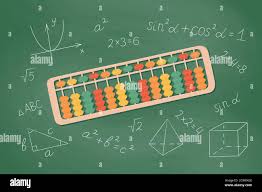
The Abacus & Mental Math Course is designed to build strong mathematical foundations in children using ancient calculation techniques blended with modern learning methods. The program develops a child’s concentration, memory, visualization, speed, and accuracy through powerful arithmetic training. This course takes students from beginner to advanced levels, ensuring they master both physical abacus operations and high-speed mental math, even without using the abacus.
Module 1: Introduction to Abacus & Mental Math
The course begins by introducing children to the origins, evolution, and importance of the abacus. Kids learn how this ancient tool became one of the fastest ways to perform arithmetic. This foundation builds excitement and curiosity.
Topics Covered:
What is an Abacus?
History & evolution of abacus
Benefits of learning abacus
Understanding mental math vs traditional math
How abacus develops the brain
Right-brain and left-brain coordination in children
Fun activities include observing old counting tools, relating abacus beads to everyday objects, and playing number-recognition games.
Module 2: Understanding the Abacus Structure
Children explore the abacus device physically. They learn how to hold it, adjust beads, and become comfortable with bead movement.
Concepts Introduced:
Parts of the abacus: frame, rods, beads, unit bar
Upper and lower beads
Place value system on the abacus
Understanding ones, tens, hundreds, thousands
Finger techniques for bead movement
Sitting posture and hand-eye coordination
By the end of this module, children learn to confidently use both hands on the abacus, preparing them for speed-based calculations.
Module 3: Basic Calculations with Abacus (Level 1 Skills)
This module teaches the foundation of arithmetic operations on the abacus. Kids practice structured techniques that help them solve numbers faster.
Topics & Skills:
Counting beads efficiently
Addition: simple, double-digit, triple-digit
Subtraction: borrow-free techniques
Understanding complements of 5 & 10
Small friend and big friend concepts
Introduction to speed drills
Activities include solving worksheets, flash-card practice, and playing speed-based number games.
Module 4: Intermediate Abacus Operations (Level 2 Skills)
Students advance to more complex arithmetic and begin using multiple rods while maintaining accuracy. This level improves visualization and attention to detail.
Key Concepts Learned:
Multi-digit addition & subtraction
Carry-over and borrow techniques
Faster friend formulas
Mental balancing
Combining 5-unit and 10-unit complements
Understanding multiple place values
Daily practice sessions begin to include:
Speedwriting
Oral calculations
Timed tests
Module 5: Introduction to Mental Visualization
Here, students learn to imagine the abacus in their mind. This is the beginning of mental math, where calculations happen without the physical tool.
Topics:
What is mental visualization?
How to see abacus beads in the mind
Memory-building exercises
Focus enhancement techniques
Left-to-right calculation habits
Activities:
Guided visualization
Short mental math sessions
Listening to audio numbers while calculating mentally
This module improves focus, concentration, and imagination power.
Module 6: Multiplication Using Abacus (Level 3 Skills)
This module introduces multiplication in a structured way that simplifies complex calculations for children.
Skills Taught:
Understanding multiplication as repeated addition
Single-digit × single-digit
Single-digit × double-digit
Double-digit × double-digit
Multiplication formula techniques
Using multiple rods efficiently

 0.0 Average Ratings
 0 Reviews
 14 Years Experience
 Near Gachibowli Stadium, Gachibowli